
Geochemical diagram guide
TAS diagram: total alkali–silica classification of volcanic rocks
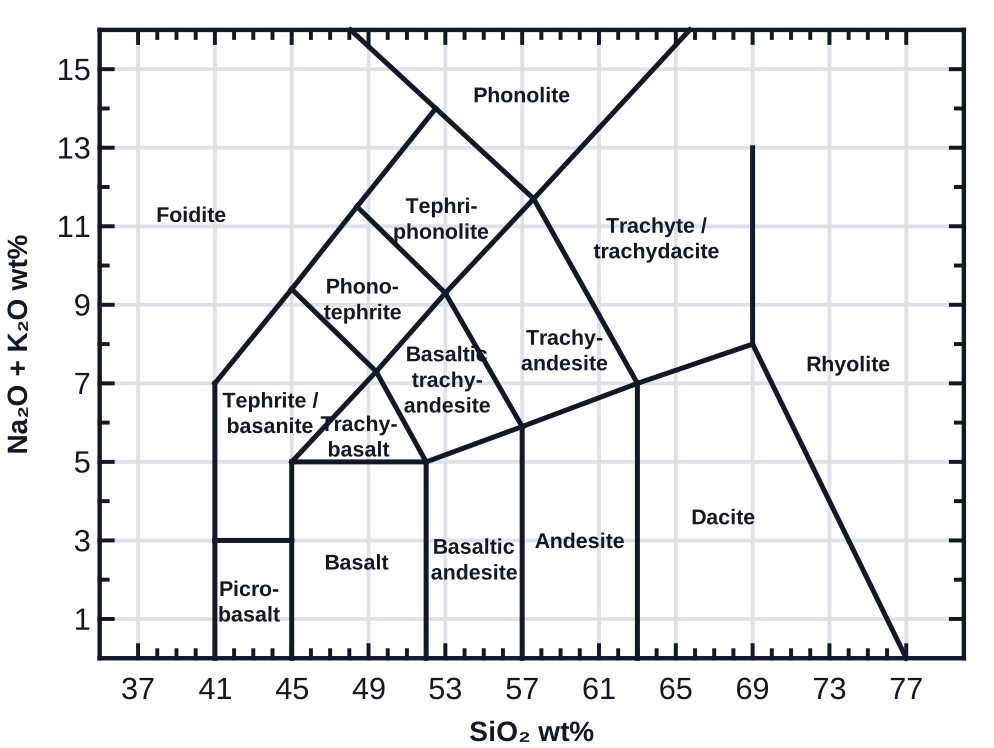
The TAS diagram plots Na₂O + K₂O against SiO₂ to name volcanic rocks from their whole-rock chemistry. Kaligeos draws the IUGS fields of Le Bas et al. (1986) and plots your samples directly from a CSV or Excel table.
Kaligeos Community is free for Windows 10 and 11. Your account includes 50 vector exports (SVG or PDF).
What the TAS diagram shows
The total alkali–silica (TAS) diagram is the IUGS-recommended chemical classification for volcanic rocks when their mineralogy cannot be determined, as in fine-grained or glassy samples. Silica (SiO₂, wt%) runs along the horizontal axis and total alkalis (Na₂O + K₂O, wt%) along the vertical axis.
Its fields separate ultrabasic, basic, intermediate and acid compositions from left to right, and subalkaline from alkaline compositions from bottom to top: picrobasalt, basalt, basaltic andesite, andesite, dacite and rhyolite along the lower series; trachybasalt to trachyte and tephrite to phonolite and foidite in the alkaline part.
Data you need
- SiO₂, Na₂O and K₂O in wt% for each sample. No iron or trace elements are required.
- Kaligeos computes Na₂O + K₂O from the Na₂O and K₂O columns.
- Kaligeos plots the oxides as imported. Le Bas et al. (1986) recommend recalculating analyses to 100% on a volatile-free basis first, so do that in your table if your totals include LOI.
How to read it
Each sample takes the name of the field it falls in. Points near a boundary deserve caution, because analytical uncertainty and alteration (especially mobility of Na and K) can move a sample across a line.
The dashed alkaline–subalkaline divide of Irvine & Baragar (1971) is often added to separate the two magmatic series; subalkaline samples can then be split into tholeiitic and calc-alkaline series with an AFM diagram.
Plotting a TAS diagram in Kaligeos
- Import CSV or Excel (.xlsx, .xlsm) tables. Kaligeos recognizes common oxide and element headers regardless of case, accents or punctuation, for example FeOt, FeO*, “La ppm” or “La (ppm)”.
- Values below detection such as “<0.5” are imported as half the limit by default; you can choose L/√2, a custom fraction or leave them empty.
- The 15 fields of Le Bas et al. (1986) are drawn with codes, full names or hidden labels; labels can be dragged into place.
- Optional Irvine & Baragar (1971) alkaline–subalkaline line with its own colour and width.
- Crop the SiO₂ and alkali ranges to focus on part of the diagram, and adjust ticks, frame and legend.
- Built-in sample filters for the basalt, basaltic andesite, andesite, dacite and rhyolite fields, plus the IUGS picrite criteria of Le Bas (2000).
- Group samples with reusable legend schemes, keep several diagrams linked to the same selection and save views inside a .kaligeos project.
- Export the figure as SVG or PDF for papers, theses and posters. Kaligeos Community includes 50 vector exports per account.
Frequently asked questions
- Which version of the TAS diagram does Kaligeos use?
- The IUGS classification of Le Bas, Le Maitre, Streckeisen & Zanettin (1986), with SiO₂ from 35 to 80 wt% and Na₂O + K₂O from 0 to 16 wt% by default.
- Does Kaligeos recalculate my analyses to an anhydrous basis?
- No. Samples are plotted with the oxide values you import. If your totals include loss on ignition, normalize them to 100% volatile-free in your spreadsheet before importing.
- Can I use the TAS diagram for plutonic rocks?
- The TAS fields are defined for volcanic rocks. Plutonic rocks are normally classified with modal mineralogy (QAP), although TAS-style plots with plutonic names are also used in the literature.
References
- Le Bas, M. J., Le Maitre, R. W., Streckeisen, A. & Zanettin, B. (1986). A chemical classification of volcanic rocks based on the total alkali–silica diagram. Journal of Petrology 27, 745–750.
- Irvine, T. N. & Baragar, W. R. A. (1971). A guide to the chemical classification of the common volcanic rocks. Canadian Journal of Earth Sciences 8, 523–548.
- Le Bas, M. J. (2000). IUGS reclassification of the high-Mg and picritic volcanic rocks. Journal of Petrology 41, 1467–1470.